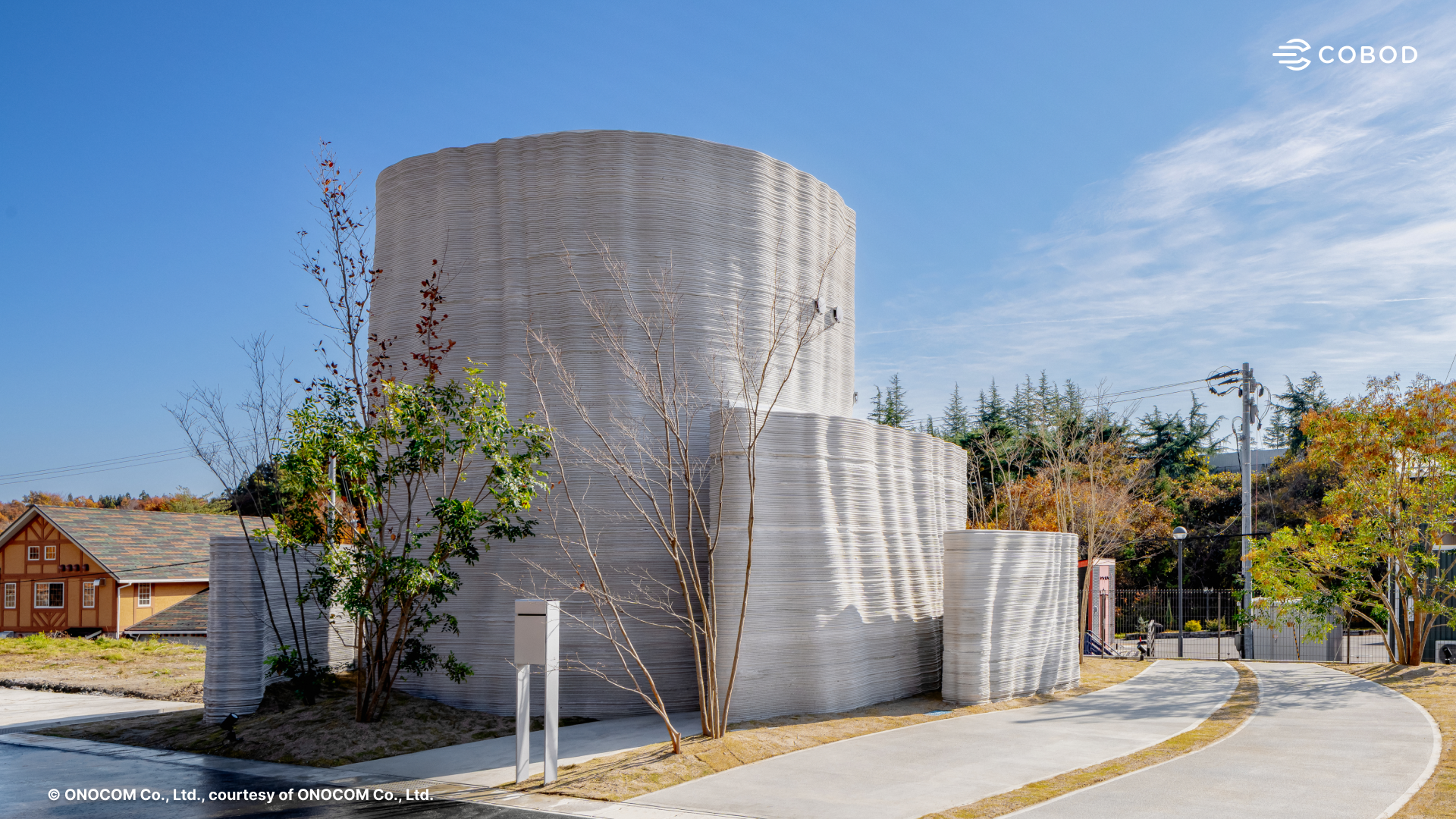
Japan, November 2025 – Kizuki Co., Ltd., in collaboration with ONOCOM, has completed Japan’s first government approved two-story 3D printed reinforced concrete house. The project meets Japan’s stringent seismic design requirements and demonstrates that 3D printed reinforced concrete can be applied as a structural alternative to timber construction in one of the world’s most earthquake-prone regions.
The COBOD 3D printer used for the project is owned and operated by Kizuki, who executed the on-site printing and construction works in Japan.

- First government approved two-story 3D printed reinforced concrete house in Japan
- Full seismic compliance confirmed under national building standards
- Total printed area of 50 m² (537 sq.ft.) across two floors using 39 m³ (1,371 cu.ft.) of material
- Cave-inspired architecture featuring 3D printed arches, floor slab, and roof slab
- Four-person crew operating the printer under seasonal conditions ranging from below 10 °C (50 °F) to 35 °C (95 °F)
- Custom printer configuration enabling printing from 0,5 m (20 in) below ground to a total height of 7 m (23 ft)
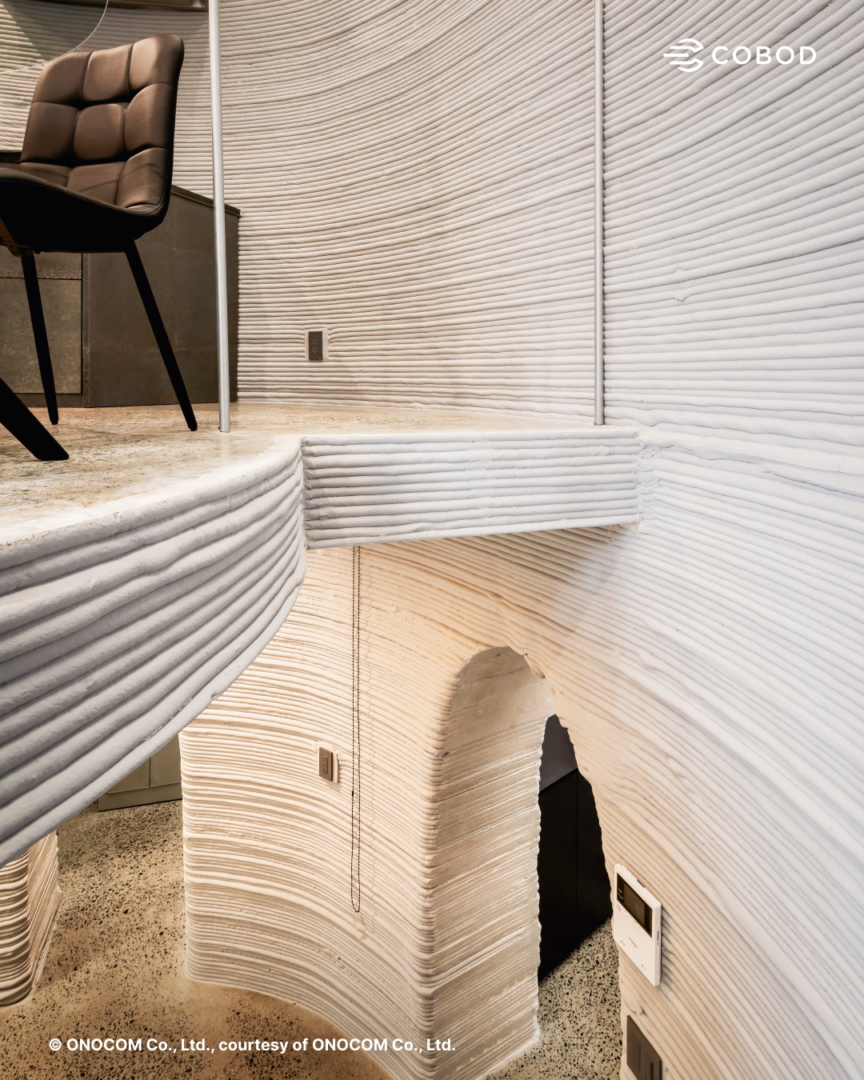
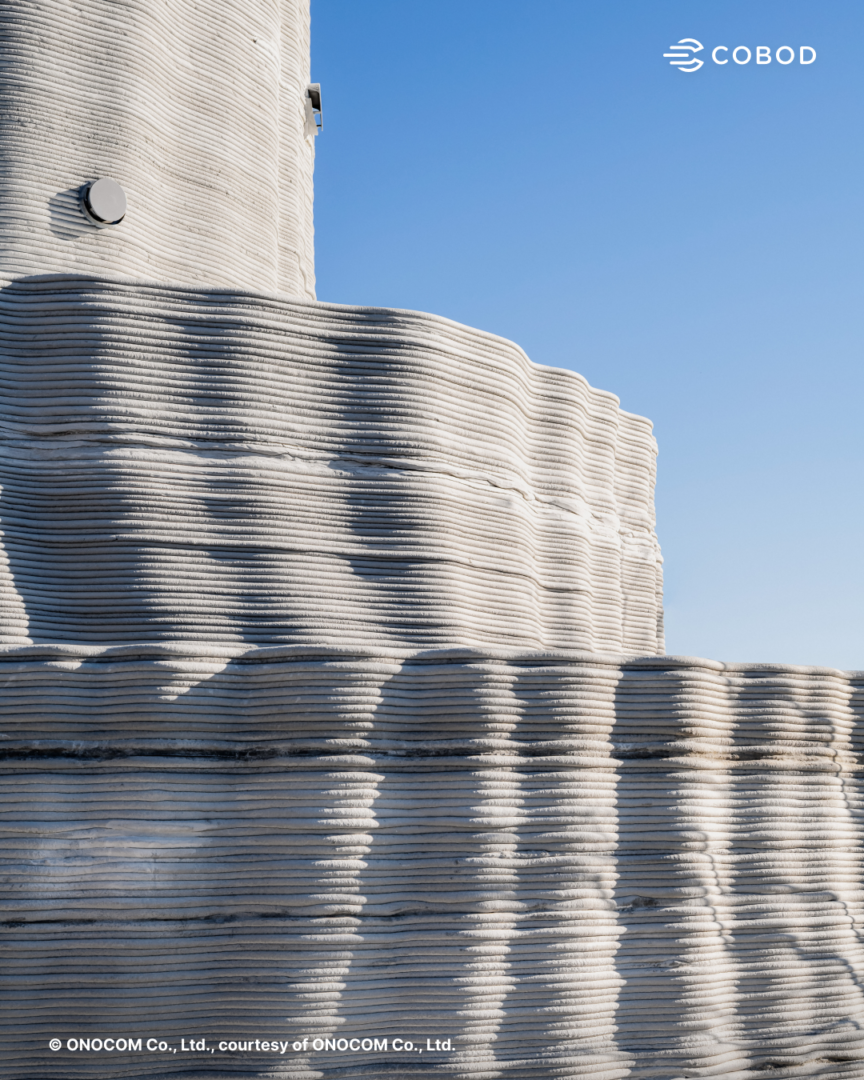
The 50 m² (537 sq.ft.) house consists of a 31 m² (329 sq.ft.) ground floor and a 19 m² (209 sq.ft.) upper floor. The design follows a cave-inspired architectural concept, incorporating 3D printed arches, a 3D printed floor slab, and a 3D printed roof slab. Several interior elements were produced using 3D printing to extend the curved geometry throughout the interior.

The project represents a new path for Japan’s residential construction sector, where timber remains the dominant material due to familiar workflows, regulatory clarity, and long established craftsmanship. At the same time, demographic change and an aging workforce are placing pressure on conventional building methods. By delivering a fully 3D printed reinforced concrete structure that satisfies Japanese seismic standards, Kizuki has demonstrated that automated construction can support structural resilience, design flexibility, and reduced reliance on manual labor.
With this project, Japan has completed its first government approved two-story 3D printed reinforced concrete house. The technical and regulatory learnings from Kurihara are now informing Kizuki’s next development phases, as the company evaluates broader applications where seismic performance, execution speed, and reduced dependence on manual labor are critical. The project demonstrates how 3D construction printing can deliver structurally sound, repeatable, and efficient building solutions under demanding regulatory and environmental conditions.
Rika Igarashi, CEO of Kizuki Co., Ltd. said:
“Based on the knowledge gained through our recent residential construction project, we plan to expand the application of 3D printing technology into civil structures, disaster-prevention and defense infrastructure, and post-disaster reconstruction. We are also developing a construction training program and a digital construction management system, aiming to establish a sustainable construction-industry model.”
Henrik Lund-Nielsen, Founder and General Manager of COBOD International, commented:
“Japan has some of the most demanding seismic requirements in the world. Seeing a government approved 2-story 3D printed reinforced concrete house completed here confirms that 3D construction printing is ready for projects that rely on structural precision and consistent quality, also in seismic areas. The collaboration demonstrates how our technology handles complex geometry, varying climate conditions, and strict regulatory standards.”
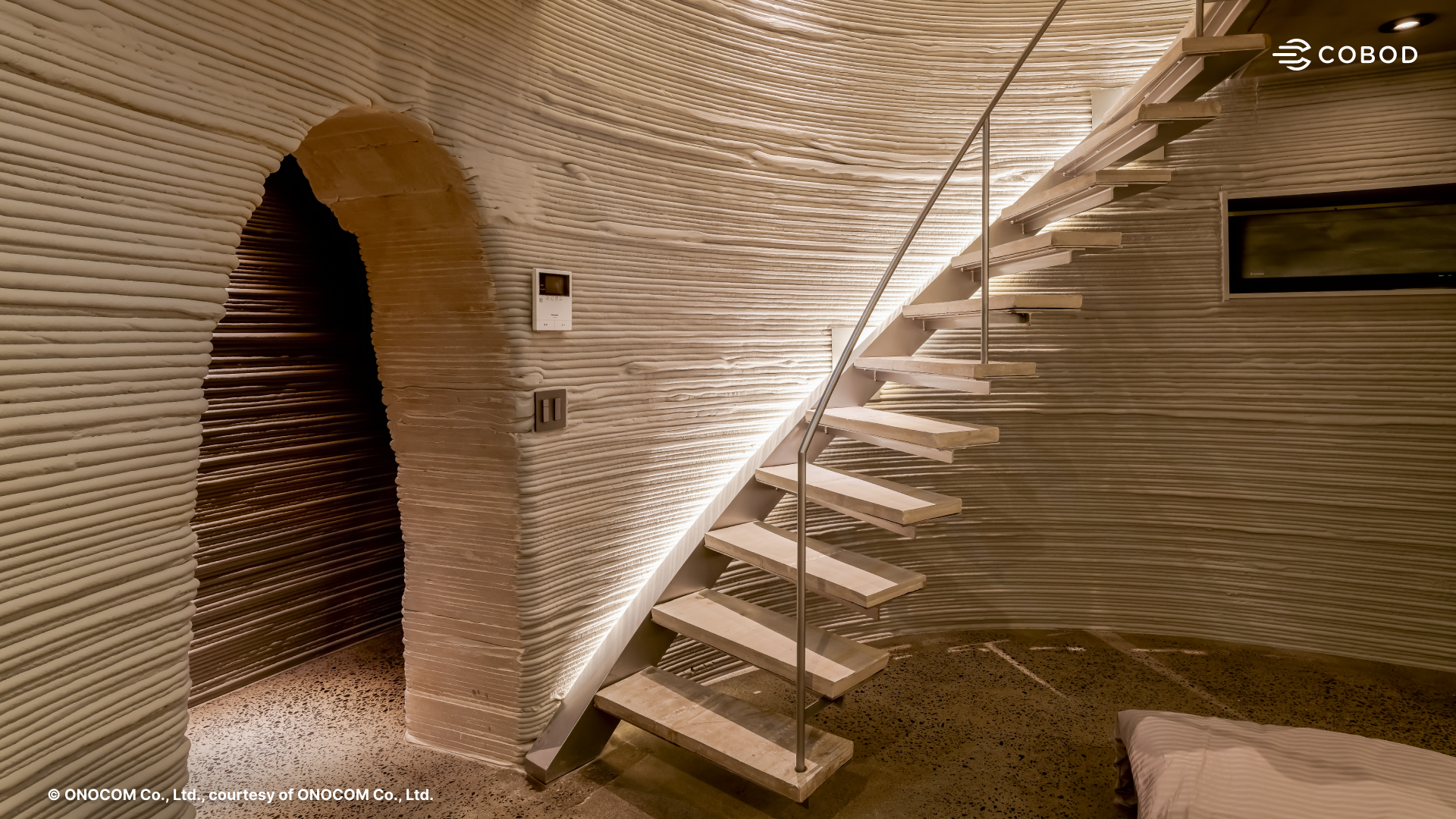
Realizing the cave-inspired architectural concept required advanced geometry beyond what is practical with conventional formwork. Kizuki combined on-site and off-site 3D printing to achieve the required structural and architectural forms. The characteristic arches were printed longitudinally rather than as prefabricated elements to avoid handling heavy, fragile cured segments. CNC-cut styrofoam supports were added incrementally during printing, enabling overhangs of up to 90 degrees while maintaining unobstructed printer movement. After printing, selected wall sections were polished to create a smooth, marble-like finish, turning the layered surface of the printed concrete into a deliberate architectural feature.
The project also validated COBOD’s technology across Japan’s extreme seasonal conditions. Early formwork components were printed in winter at temperatures below 10 °C (50 °F), requiring heated mixing water to maintain printability. The main house was printed in summer at 30–35 °C (86–95 °F), where the high temperature shortened bucket life and required careful process control.

Relevant Links
- COBOD International: www.cobod.com
- Kizuki Co., Ltd.: https://kizuki3dcp.com/
- ONOCOM Co., LTD.: https://www.onocom.co.jp/adc/
About COBOD International
COBOD International stands as the global leader in supplying 3D printers for the construction sector, with over 85 printers distributed across North and Latin America, Europe, the Middle East, Africa, and Asia-Pacific. Driven by a vision to build smarter through multifunctional construction robots based on 3D printing, COBOD envisions automating half of the construction processes to achieve faster, cost-effective, sustainable results with enhanced design versatility.
From residential, commercial, and public buildings, COBOD’s 3D printers have been instrumental in erecting 1- to 3-story structures across all six inhabited continents. The innovative technology also extends to fabricate large-scale data centers, wind turbine towers, tanks, and more.
Embracing an open-source material approach, COBOD collaborates with global partners, including customers, academia, and suppliers. The company, backed by prominent shareholders such as General Electric, CEMEX, Holcim, and PERI, operates from its main office in Copenhagen, Denmark, and regional locations in Miami, Florida, and Kuala Lumpur, Malaysia. COBOD’s dynamic team comprises over 100 professionals from 25 diverse nationalities.
About Kizuki Co., Ltd.
Kizuki Co., Ltd. is a construction technology company that owns and operates 3D construction printing equipment and is advancing the real-world adoption of 3D concrete printing, with a focus on 3D-printed construction. From housing to disaster-resilient and infrastructure applications, we connect local communities with emerging construction technologies to deliver practical, scalable building solutions.
About ONOCOM Co., Ltd.
ONOCOM operates under the corporate message “If it doesn’t exist, create it.” As a comprehensive construction company, we provide architectural design and construction services while collaborating with trusted partners to create new value and build lasting trust.
To advance next-generation construction, ONOCOM established the ADC Promotion Office (Advanced Design & Construction) to lead its 3D concrete printing (3DCP) initiatives. In Japan, we successfully completed Japan’s first two-story 3D-printed house and continue to advance the validation and refinement of the technology.
In the Philippines, we introduced COBOD’s BOD3 3D concrete printer to help address the country’s significant housing shortage. By utilizing locally available concrete materials, we aim to contribute to more efficient, scalable, and sustainable construction solutions.
Looking ahead, ONOCOM continues to explore the broader potential of 3D printing and advanced construction technologies, not only for housing, but also for commercial architecture and innovative interior manufacturing.
Interested in 3D construction printing?
Whether you have a project in mind or just want to learn more, we’re happy to talk.