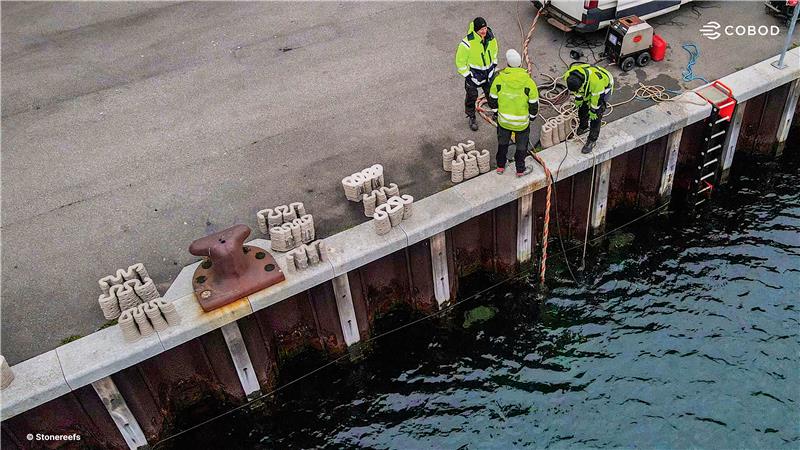
Copenhagen, September 2025 – COBOD’s 3D construction printing technology is helping restore marine biodiversity in Danish harbors by enabling large-scale deployment of artificial reef modules. In partnership with StoneReefs (part of 3DCP GROUP) the custom-designed modules are printed on a COBOD BOD2 3D Construction printer and are already installed in several harbors across Denmark with more locations to follow.
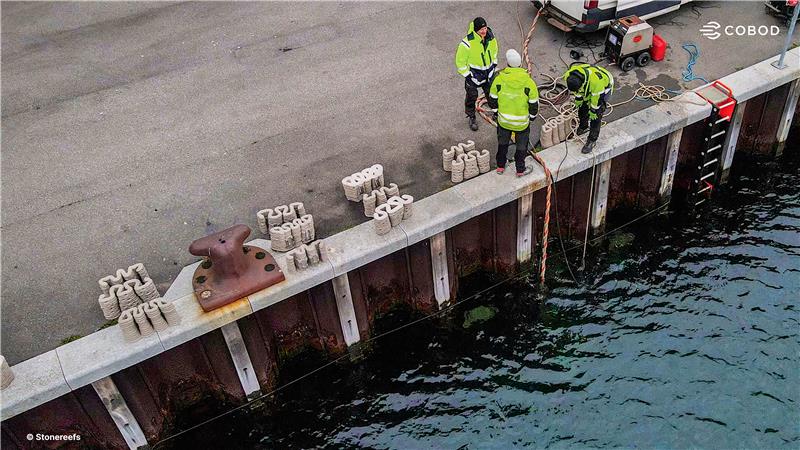
- BOD2 printer enables custom reef-textured modules that integrate seamlessly into quay sheet pile walls without disrupting port operations
- Installations completed in Copenhagen, Aarhus, Korsør, Helsingør, Sprogø and Fredericia with more underway
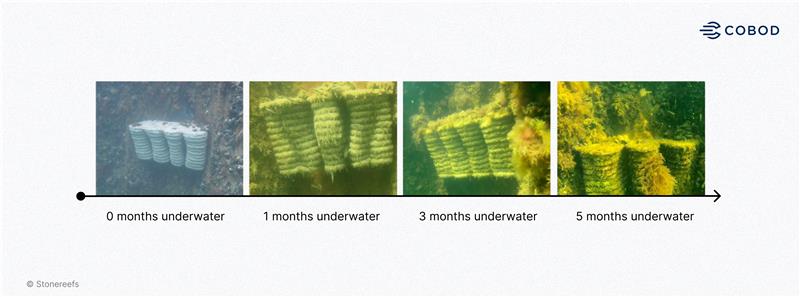
- Rapid positive ecological response observed as algae, mussels and smaller fish colonize within months and in Fredericia even cod and eel have returned
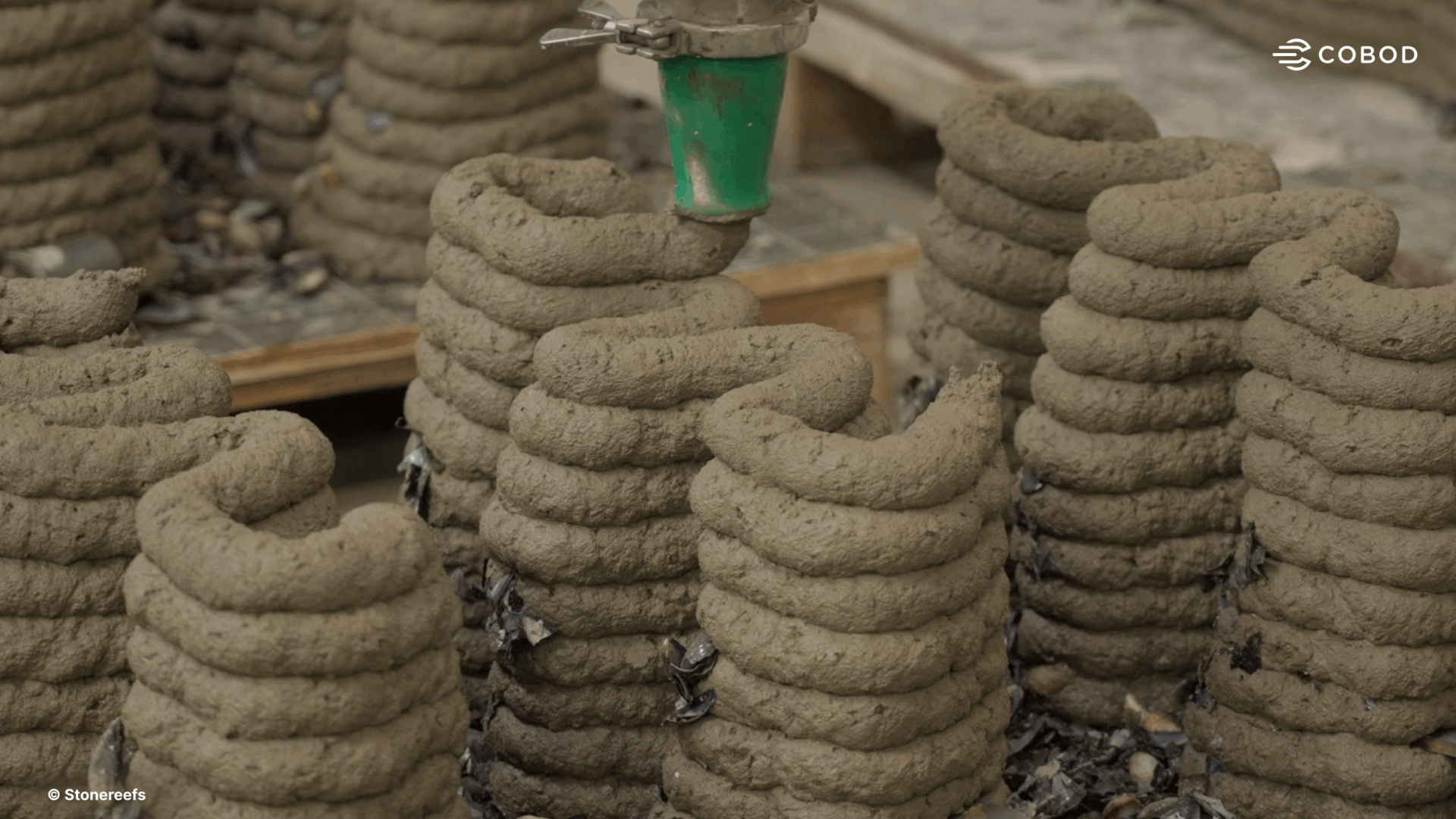
- Modules are 3D printed with CO₂-reduced cement, local aggregates and crushed mussel shells to encourage marine life
- Project partners include Orsted, Sund & Baelt, WWF Denmark and By & Havn with students engaged in biodiversity education
Modern ports rely on vertical steel sheet pile walls that are efficient for docking but harsh on marine ecosystems. With the precision of 3D printing, StoneReefs produces reef-textured concrete modules that mount seamlessly onto these quay walls. The layered surfaces, grooves, and cavities create micro-habitats that support smaller marine organisms. These features are difficult and costly to reproduce with traditional molds, yet with 3D printing they become repeatable and scalable. Within only a few months underwater the modules attract algae, mussels and smaller fish and in Fredericia harbor even cod and eel have returned.
The modules are printed using CO₂-reduced cement and local aggregates combined with a proportion of crushed mussel shells that help larvae settle and speed up colonization. This material approach is made possible through COBOD’s open-source material strategy and has been developed with partners such as Holcim.
Installations are supported by leading organizations including Orsted and Sund & Baelt and in collaboration with WWF Denmark and By & Havn. Students have taken part by designing their own reef concepts and observing the developments through underwater viewers and live camera feeds that allow the students to follow the reef’s growth in real time.
“3D printing lets us improve biodiversity without disturbing harbor activities” said Mikkel Brich, co-founder and CEO of 3DCP Group and StoneReefs. “We make modules that match the wall geometry to not interfere with daily operations but provide the textures marine life needs. We experience that when you give nature a foothold life, returns within months.”
Henrik Lund-Nielsen, Founder and General Manager of COBOD International, added “It is great to see our 3D construction printing technology at work just around the corner from our headquarters in Nordhavn Harbor. StoneReefs shows the benefits of our technology including the design freedom, material flexibility through our open materials approach and scalability. These strengths can be applied to many offshore and marine applications that help restore biodiversity. The project demonstrates how construction technology can serve both industry and nature, with potential for wider marine and offshore applications.”
RELEVANT LINKS
- COBOD BOD2 3D Construction Printer: The BOD2 | COBOD International
- StoneReefs: https://www.stonereefs.com/
- Bring back Biodiversity: Stonereefs – Bring Back Biodiversity (Explainer) – YouTube
- Development of Biodiversity: Stonereefs – Biodiversitetens udvikling over 4 måneder
3DCP Group: 3DCP Group
ABOUT COBOD
COBOD International stands as the global leader in supplying 3D printers for the construction sector, with over 85 printers distributed across North and Latin America, Europe, the Middle East, Africa, and Asia-Pacific. Driven by a vision to build smarter through multifunctional construction robots based on 3D printing, COBOD envisions automating half of the construction processes to achieve faster, cost-effective, sustainable results with enhanced design versatility.
From residential, commercial, and public buildings, COBOD’s 3D printers have been instrumental in erecting 1- to 3-story structures across all six inhabited continents. The innovative technology also extends to fabricate large-scale data centers, wind turbine towers, tanks, and more.
Embracing an open-source material approach, COBOD collaborates with global partners, including customers, academia, and suppliers. The company, backed by prominent shareholders such as General Electric, CEMEX, Holcim, and PERI, operates from its main office in Copenhagen, Denmark, and regional locations in Miami, Florida, and Kuala Lumpur, Malaysia. COBOD’s dynamic team comprises over 100 professionals from 25 diverse nationalities.
ABOUT STONEREEFS
StoneReefs is a Danish company that specializes in developing 3D printed concrete artificial reefs. Using COBOD 3D construction technology, the company 3D prints reef modules that mount onto existing sheet piles to support marine biodiversity. 3D printing makes it possible to create complex shapes that provide hiding places for marine life and allows for straightforward installation.
ABOUT 3DCP GROUP
3DCP Group consists of an engineering company, architecture firm, and the constructing party, which combined possess all the skills necessary to 3D print a complete building. This gives 3DCP a unique opportunity to take care of the entire construction process, from idea to turn-key product.
3DCP’s ambition is to build better, cheaper, and more sustainably.
When the company says its ambition is to build better, it doesn’t just mean the objective quality of the house, but also the subjective experience of the house, all of which is made possible through the construction method and the surrounding processes.
Interested in 3D construction printing?
Whether you have a project in mind or just want to learn more, we’re happy to talk.