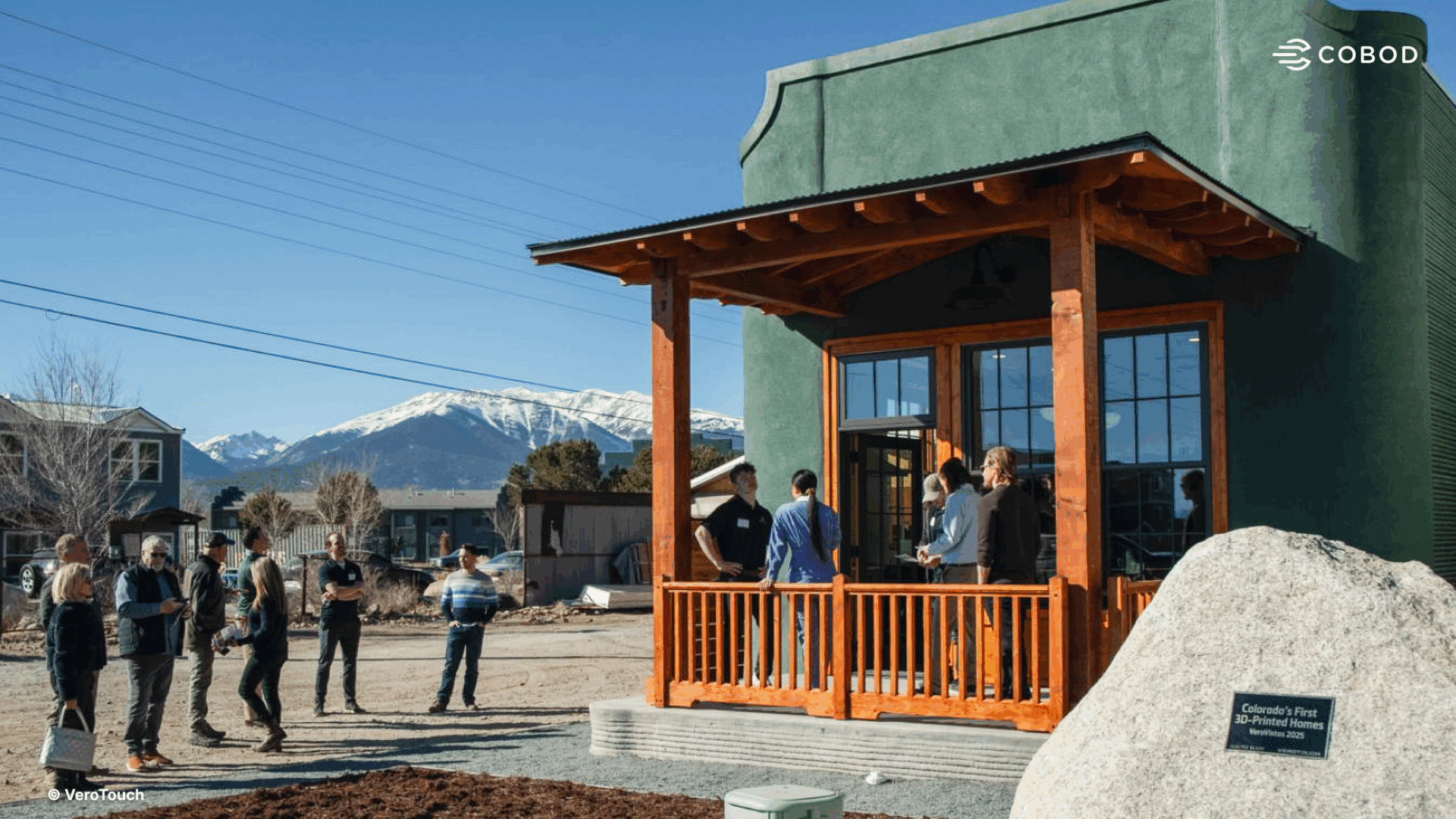
- VeroTouch in partnership with local developer South Main 3D printed two 1,100 sq. ft. (102 m2) homes with A1-rated concrete walls, the highest standard for fire safety, a much-desired feature in Colorado, where nearly half of the population lives in regions at risk of wildfires.
- The second home’s superstructure was 3D printed in just 16 days using COBOD’s BOD2 3D printer, significantly reducing build time compared to conventional construction.
- Supported by a $680,000 IHIP grant, VeroTouch is now scaling up 3D printing to help meet Colorado’s housing needs.

Colorado, 2025 – The two homes in Buena Vista, each spanning 1,100 sq. ft. (102 m2), are built with A1-rated 3D printed concrete walls, which offer the highest level of fire resistance and do not fuel combustion at any stage. This provides a critical safety advantage in Colorado, where nearly half of the population lives in regions at risk of wildfires. The ability to print with real concrete and support an open-source material system sets COBOD’s technology apart in the 3D construction industry. It allows customers to customize their printable material mix to local conditions. Whether adapting to wildfire zones, seismic activity, or extreme temperature shifts, this adaptability makes 3D printed structures more resilient.
The superstructure of one home was completed in just 16 days, far faster than conventional construction, demonstrating the significant productivity gains made possible by this innovative, automated approach. The 3D construction printer follows a predefined path with precision, reducing manual labor while consistently delivering high-quality results. This accelerated timeline not only saves weeks of construction work but also frees up resources for faster project turnover and cost efficiency.
The VeroVistas, as the two houses are called, demonstrated the design flexibility of 3D printing. One of the homes features the characteristic layered concrete look typical of printed buildings, while the other blends in with a more traditional finish, using stucco for the walls.
“In an era of fast housing, VeroTouch is creating legacy homes that can be passed down, rather than torn down,” said Grant Hamel, VeroTouch’s Chief Executive Officer. “Beyond merely great design, we’re proud that VeroVistas homes offer a level of resilience to natural disasters like wildfires unmatched by any other product in this region. Because of that, we expect these homes to be standing strong 100 years from now.”

The 3D printed homes offer higher living quality, modern design features, and greater fire resilience than traditional wood frame houses. Unlike wood, the concrete used in the 3D printed walls does not contribute to fire spread, offering greater stability and protection. Priced at around $625,000, near the average for homes in Colorado’s mountain communities, these homes combine enhanced safety with competitive market value.

By working with local contractors, VeroTouch is keeping jobs in the region, supporting the local economy and introducing a new construction technology. For this innovative approach VeroTouch received support from Colorado’s Innovative Housing Incentive Program (IHIP), which aims to support the construction of 7,500 homes over the next three years. This underscores the potential of 3D construction printing as a solution to the ongoing housing crisis. As part of this initiative:
“We are proud to accelerate innovation in housing to better address Colorado’s housing needs,” said Governor Jared Polis. “The unveiling of these 3D printed homes is a great example of how we can support new building methods to create more housing now.”
Eve Liebmann, Executive Director of Colorado Office of Economic Development and International Trade (OEDIT), added: “We commend VeroTouch for helping increase the supply of housing, which will allow more Coloradans to live in the communities they love.”
After the success of the first two 3D printed homes, VeroTouch has already begun work on its next development: a 32-home neighborhood in Salida, a growing region of Colorado. Construction of the first house is underway, and the company has expanded its team to meet the increasing demand for safe, 3D printed homes.
Philip Lund-Nielsen, Co-founder and Head of Americas at COBOD International, concluded: “3D construction printing provides a safer, more efficient, and sustainable way to build. Colorado investing in broader application of 3D construction printing shows that this scalable method can help address the housing crisis, not only in Colorado, but across the U.S.”
This successful project by VeroTouch demonstrates how 3D printing is impacting the construction industry, offering a more efficient solution for building homes that meet today’s higher safety standards. COBOD’s BOD2 printer continues to prove that 3D construction printing is a viable option for residential housing, especially in areas facing the challenges of wildfires and other natural disasters. With the increasing demand for safer, affordable, sustainable housing, 3D printing is emerging as a key method for building faster and more sustainable and economical homes.
RELEVANT LINKS
COBOD International: World leader in 3D construction printing | COBOD
BOD2 3D Construction Printer: The BOD2 | COBOD International
VeroTouch: https://verotouch.com/
ABOUT COBOD
COBOD International stands as the global leader in supplying 3D printers for the construction sector, with over 85 printers distributed across North and Latin America, Europe, the Middle East, Africa, and Asia-Pacific. Driven by a vision to build smarter through multifunctional construction robots based on 3D printing, COBOD envisions automating half of the construction processes to achieve faster, cost-effective, sustainable results with enhanced design versatility.
From residential, commercial, and public buildings, COBOD’s 3D printers have been instrumental in erecting 1- to 3-story structures across all six inhabited continents. The innovative technology also extends to fabricate large-scale data centers, wind turbine towers, tanks, and more.
Embracing an open-source material approach, COBOD collaborates with global partners, including customers, academia, and suppliers. The company, backed by prominent shareholders such as General Electric, CEMEX, Holcim, and PERI, operates from its main office in Copenhagen, Denmark, and regional locations in Miami, Florida, and Kuala Lumpur, Malaysia. COBOD’s dynamic team comprises over 100 professionals from 25 diverse nationalities.
ABOUT VEROTOUCH
VeroTouch is a construction technology company that believes housing is a fundamental human right, and that solutions to the housing crisis will come from private sector invention and investment. Proudly founded in the High Country of Colorado in 2023, VeroTouch implements and refines advanced construction technologies—including 3d concrete printing, panelized manufacturing, material science innovations, and automated building processes. Beyond just speed and cost, VeroTouch‘s technologies produce homes that are more resilient in the face of natural disasters, more efficient to heat and cool, yield less waste,utilize more local materials, and are built to last for generations. By combining 3D printed concrete for structural elements with offsite panelized systems for interiors, we achieve faster build times and greater design flexibility, differentiating us from traditional builders and pure 3D printing competitors.
Interested in 3D construction printing?
Whether you have a project in mind or just want to learn more, we’re happy to talk.