Print with regular concrete. No lock-in.
HOW YOU SUPPLY THE MATERIAL
Three ways to print with real concrete
All COBOD printers run on locally sourced concrete. You choose the supply method that fits your project. We do not recommend printing with mortar, although it is possible.

HIGH VOLUME
Ready-mix truck (RMC)
A ready-mix truck delivers concrete directly to the printer. Simplest setup, no on-site mixing equipment needed.
Highest throughput, trucks run continuously
Simplest on-site logistics
No additional equipment required
BEST FOR: LARGE URBAN PROJECTS WITH LOCAL SUPPLIERS

FLEXIBLE
Volumetric truck
A truck that mixes concrete on the move. Flexible mix ratios, no fixed infrastructure, good for variable project sizes.
Mix adjustable on the fly
Mix adjustable on the fly
Good for mid-size or variable projects
BEST FOR: MID-SIZE PROJECTS NEEDING MIX FLEXIBILITY

FULL CONTROL
On-site batch plant
Concrete mixed on-site from raw materials. Works in remote locations or where RMC supply is unavailable. COBOD offers a mini batch plant, but any compatible system works.
Full control of mix parameters
Works anywhere, no supplier dependency
Best for varying climates and remote sites
BEST FOR: REMOTE SITES, VARIABLE CLIMATES, LARGE DEVELOPMENTS
WHY IT MATTERS
Real concrete vs pre-bagged mortar
Most 3D construction printers require proprietary dry-mix mortars. COBOD prints with real concrete. Printing with mortar is possible, but we do not recommend it. The difference shows up immediately in your project economics.
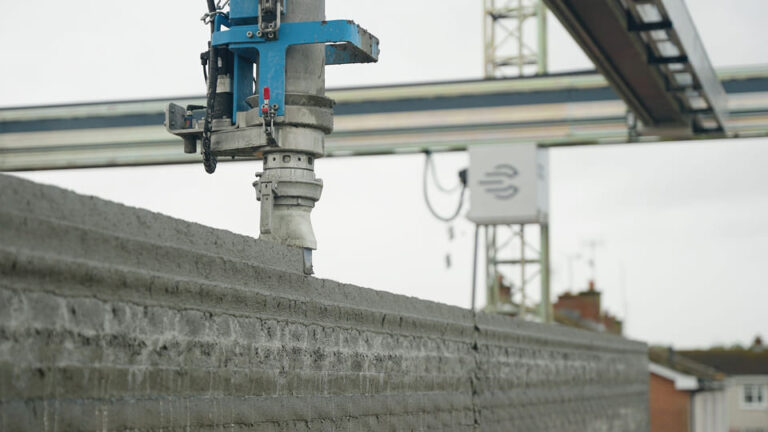
RECOMMENDED
Regular concrete, sourced locally
Truck-delivered or batched on-site using standard raw materials.
70-80% lower material cost
~$150-250 per m³ (~$100-200 per cubic yard)
3-5x faster builds
Productive 7-10 cm (3-4 inch) print layers
Standard materials, simpler permitting
Regular 4,000+ PSI (28 MPa) concrete, up to 10 mm (3/8") stone
Full control of your mix
Adapt to weather, site conditions, and local materials
No supply chain lock-in
Source from any local concrete supplier
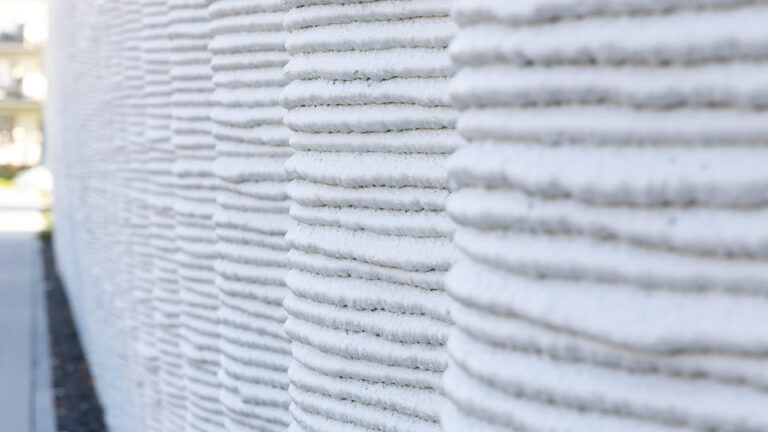
NON-STANDARD ALTERNATIVE
Pre-bagged mortars
Proprietary dry-mix delivered in bulk bags from factory.
4-5x higher material cost
~$800-1000 per m³ (~$1000+ per cubic yard)
Slow printing
Small 1-2 cm (0.5-1 inch) layers
Locked into proprietary supply chain
No local sourcing, no mix flexibility
Limited climate flexibility
Fixed mix cannot adapt to site conditions
$30,000+ higher cost per home
vs printing with regular concrete
LAYER HEIGHT COMPARISON
The difference you can see
Real concrete prints in tall layers, mortar in thin ones. Layer height decides how fast you finish.
Real concrete
75 mm
3–5x faster printing
Pre-bagged mortar
25 mm
Slow, thin layers
In 200 minutes of printing
75 mm layers: 3 m wall height
25 mm layers: 1 m wall height
3x taller wall in the same time
Based on 5 minutes per layer
WALL FINISH
Smooth walls. No extra steps.
A common assumption is that 3D printed concrete walls have a rough, layered finish. COBOD printers include an automatic trailing trowel on the nozzle that smooths the wall surface during printing.
No post-processing required. Concrete walls printed with COBOD can achieve the same smooth finish as conventional construction, while retaining all the structural and cost advantages of 3D printing.
WALL FINISH
Smooth walls. No extra steps.
A common assumption is that 3D printed concrete walls have a rough, layered finish. COBOD printers include an automatic trailing trowel on the nozzle that smooths the wall surface during printing.
No post-processing required. Concrete walls printed with COBOD can achieve the same smooth finish as conventional construction, while retaining all the structural and cost advantages of 3D printing.
CONTINUE EXPLORING
3D PRINTERS
Which printer uses this?
All COBOD printers run on regular concrete. See BOD2, BOD3, and BODXL and find the right system for your project.
Read more →
HOW IT WORKS
From planning to first print
Understand the full process from site preparation and permitting to printing and post-processing.
Read more →
CUSTOMER STORY
LX Construction cuts cost by 40%
A US builder switched to real concrete and delivered a commercial gymnasium at 40% below the conventional quote.
Read more →
Questions about materials for your project?
Frequently asked questions
What materials do COBOD printers use?
Standard concrete with aggregate up to 10 mm (0.4 in), sourced locally. No proprietary dry mix required. Admixtures can be added to the mix to suit local conditions and project requirements. Mortar can also be used, but we do not recommend it.
Can I source materials locally?
Yes, and this is one of COBOD’s core advantages. Local concrete eliminates supply chain dependency and reduces material costs by up to 80% compared to proprietary mortar alternatives.
How does concrete compare to mortar alternatives in cost?
Locally sourced concrete typically costs $100-200 per m³ ($75-150 per cubic yard) and prints in productive 75-100 mm (3-4 in) layers. Proprietary pre-bagged mortars cost $900-1,300 per m³ ($690-990 per cubic yard), print in slow 10-20 mm (0.4-0.8 in) layers, and lock you into a single supplier. The difference can add $30,000 or more to the cost of a single home.
Can you print curved walls?
Yes. The printer follows any geometry defined in the CAD file, including curves, arcs, and non-linear layouts. Curved walls print at the same speed as straight walls with no additional material cost.
How does 3D printing work in extreme heat or cold?
The concrete mix is adjusted to suit local climate conditions. In hot weather, cooler water is used and printed layers can be misted to prevent premature drying. In cold weather, accelerators are added to the mix. COBOD provides mix formulation support for all climates as part of the starter package.
What mix support does COBOD provide?
Mix formulation support using locally sourced materials is included in the starter package. Ongoing guidance is available through COBOD Connect and the remote diagnostics teams across three global offices.