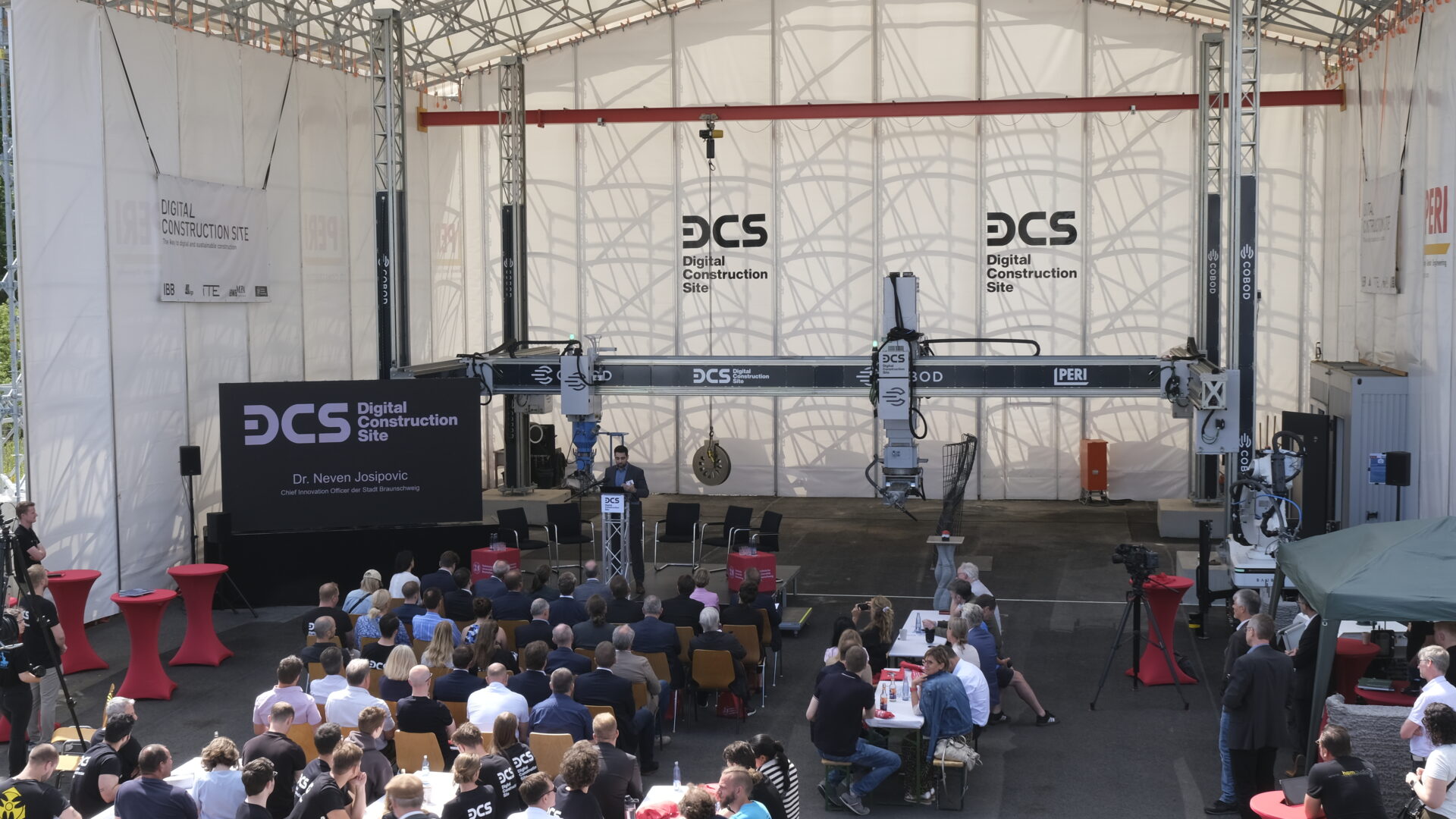
- At a launch event in Germany, COBOD International and Technische Universität Braunschweig presented COBOD’s first multifunctional construction robot.
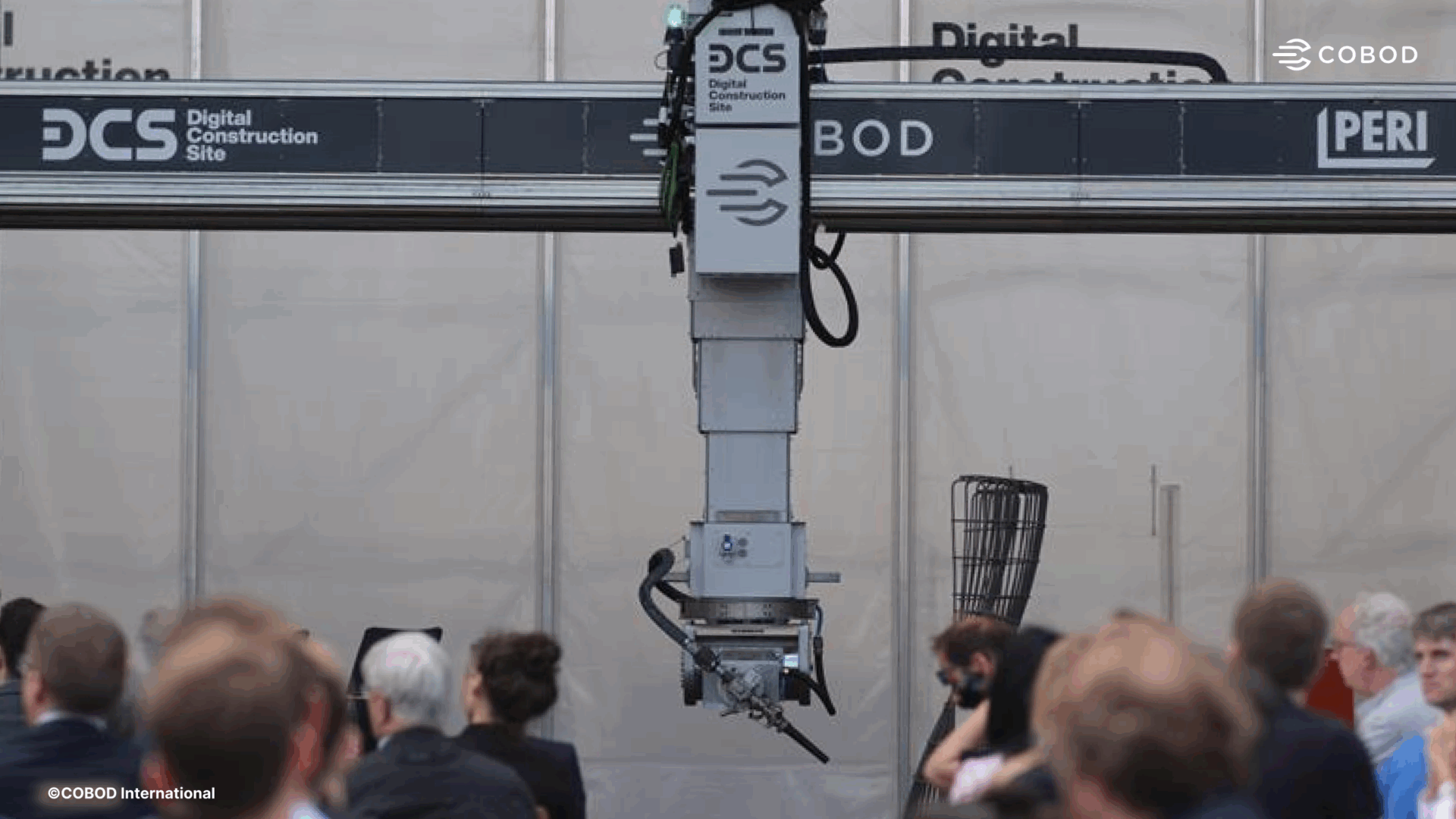
- The BOD2 3D gantry printer from COBOD is not only capable of printing concrete but can, with the help of a newly developed vertical telescopic unit with a COBOD robotic arm at the end, also spray concrete, known as shotcrete.
- The telescope unit has been developed in collaboration with the Institute for Structural Design (ITE) and is intended to expand the COBOD system for use with the Shotcrete 3D Printing (SC3DP) process.
- The installed printing system at TU Braunschweig’s Digital Construction Site (DSC) is thereby the first materialization of COBOD’s vision of developing and delivering multifunctional construction robots capable of automatically performing multiple construction functions, not just printing of concrete.
- Helga Kühnhenrich, Head of the Research and Innovation in Construction Department at the Federal Institute for Research on Building, Urban Affairs and Spatial Development (BBSR), attended the launch event, underlining the national support for automating and digitalizing construction to meet future construction and housing needs.
[July 3, 2025] Braunschweig, Germany – COBOD International, in collaboration with the Technische Universität Braunschweig, has introduced the first commercially available multifunctional construction robot. Built on COBOD’s 3D construction printing technology, the jointly developed system by COBOD and Institute for Structural Design (ITE) integrates a telescopic vertical extension unit with a robotic arm that enables the Shotcrete 3D Printing Process (SC3DP). Shotcrete is used to construct complex concrete structures like tunnels, swimming pools, retaining walls, and to reinforce concrete structures. However, the telescopic tool is not limited to shotcrete applications, multiple other tools can also be mounted onto the vertical telescopic unit. The vertical telescopic unit is mounted between two X-axes on a COBOD BOD2 3D construction printer.
The technology was demonstrated at the Grand opening of the Digital Construction Site at TU Braunschweig this week. Head of Department ‘Research and Innovation in the Construction Industry’, Federal Institute for Research on Building, Urban Affairs and Spatial Development (BBSR), Helga Kühnhenrich attended the opening event, confirming increased focus on automation within the construction industry to reduce costs and manpower requirements.

Automated fabrication of double curved walls
TU Braunschweig intends to use the system delivered to SC3DP digitally fabricated reinforced concrete structures with high surface quality and geometric freedom. Hereby the reinforcement is seen as an integral part of the SC3DP process: Either the concrete is built up first and then the reinforcement is inserted, or the reinforcement has a pre-fabricated shape and the mesh is shotcreted from both sides. Additionally, the robotic arm can be equipped with sanding equipment to finish the surfaces.
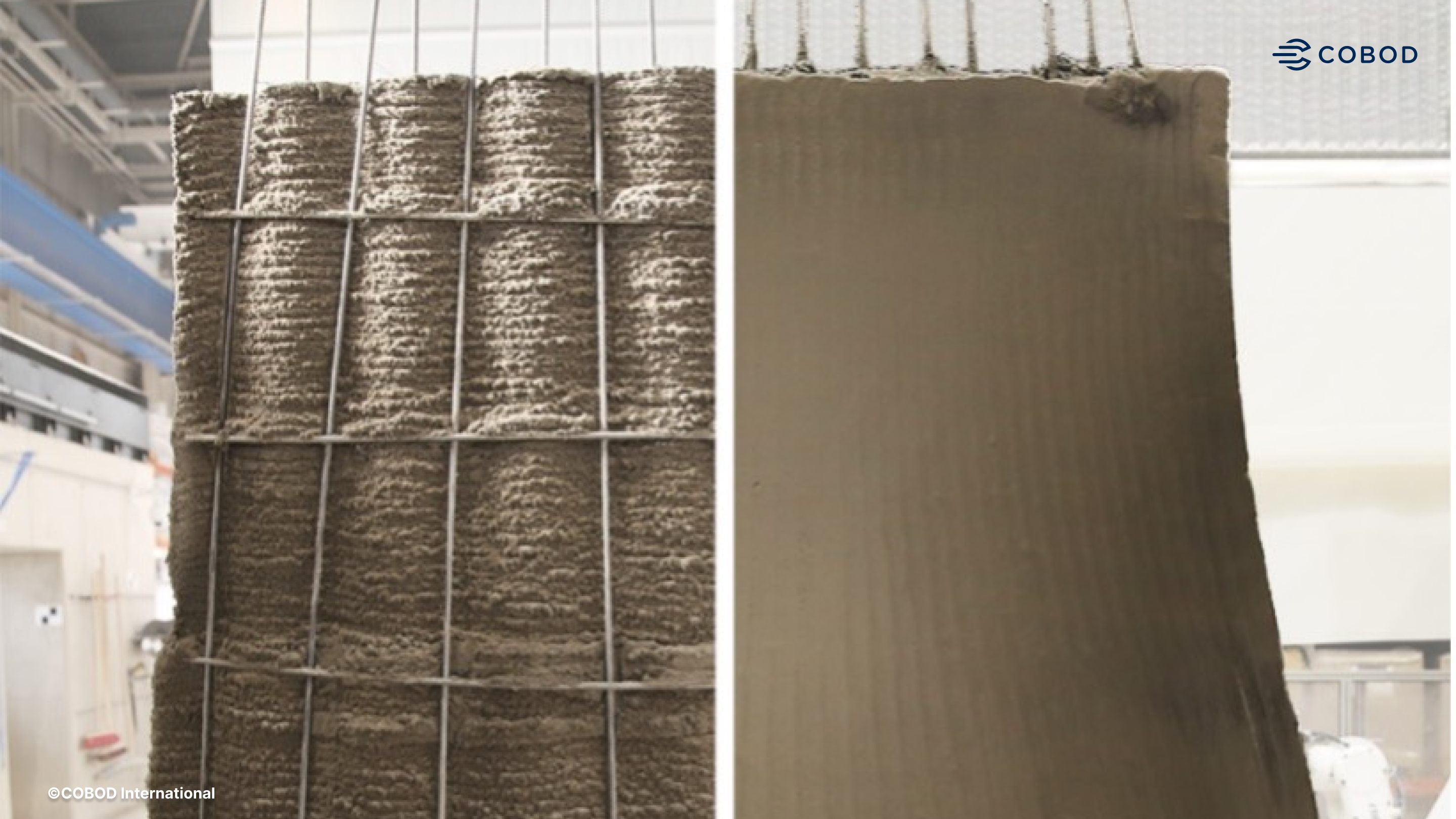
Professor Harald Kloft for Structural Design at ITE explained: “Our partnership with COBOD is a decisive step towards the digital construction site of the future. 3D printing enables automated, digitally controlled processes of simple as well as very complex tasks, like the fabrication of reinforced double curved walls. The ability to make complex, individualized, material efficient and low waste construction solutions makes 3D printing ideal for the construction industry, as it brings together economic, environmental and social aspects, such as the reduction of physical stress.”
From printing of concrete walls to multifunctional construction robots
With a dynamic vertical range of 3 meters of the telescopic unit, the robotic arm can fully reach and manipulate an already printed wall 3 meters below the X-axis.
COBOD emphasizes that a variety of tools can be mounted on the new COBOD robotic arm, such as a paint spray gun, insulation tool, sanding equipment etc., hereby turning the 3D construction printer into a multifunctional construction robot capable of much more than just the printing of the walls.

By installing a gripper system at the end of the robotic arm the robotic arm, the system can even be used to automatically mounting of aerated concrete blocks or brick or other types of pre-fabricated building components not usually associated with 3D printing solutions, underlining the new multifunctional capabilities of the printing system.

At the event, Henrik Lund-Nielsen, General Manager and Founder of COBOD International, said, “For years we have had the vision of making multifunctional construction robots on the basis of our 3D construction printers. Seeing the first materialization of our vision here makes me very proud. With this new technology we offer automation of many more construction processes than just printing of concrete walls. With our new COBOD robotic arm at the end of the telescopic arm there is an endless amount of construction tasks that our printing system can now automate and expedite to the benefit of our global customers.”
Advancing Digital and Sustainable Construction
The project, “The Digital Construction Site – Construction Industry 4.0 as the Key to a Digital and Sustainable Construction Industry)” led by TU Braunschweig, investigates how digital manufacturing technologies affect planning and production under real construction site conditions. The interdisciplinary initiative of the Institutes of Structural Design, of Construction Engineering and Management, of Geodesy and Photogrammetry and of Building Materials, Concrete Construction and Fire Safety combines research and practical application to develop frameworks that make construction more effective and affordable through automation.
COBOD’s multifunctional construction robot will now be deployed and tested in real-world building projects in collaboration with TU Braunschweig. These tests will provide critical data to guide future implementation and scaling of the technology in Germany and internationally.
Prof. Norman Hack adds: “This launch is more than a research milestone; it is the result of close collaboration with a leading industry partner in 3D printing. The multifunctional system enables us to develop and test entirely new concepts of digital fabrication directly on site. With this next generation of robotic technology, we are exploring hybrid, multi-material, and multi-process construction, enabling us to apply each material and process where it performs best, and to build more efficiently, with greater precision and adaptability.”
RELEVANT LINKS
- COBOD International: World leader in 3D construction printing | COBOD
- Henrik Lund-Nielsen, General Manager and Founder of COBOD International, explaining the multifunctional construction robot.
- The Digital Construction Site – Construction Industry 4.0 as the Key to a Digital and Sustainable Construction Industry: https://www.tu-braunschweig.de/digitale-baustelle
- TRR 277 AMC Additive Manufacturing in Construction – Collaborative Research Center : https://amc-trr277.de/
ABOUT COBOD INTERNATIONAL
COBOD International stands as the global leader in supplying 3D printers for the construction sector, with over 85 printers distributed across North and Latin America, Europe, the Middle East, Africa, and Asia-Pacific. Driven by a vision to build smarter through multifunctional construction robots based on 3D printing, COBOD envisions automating half of the construction processes to achieve faster, cost-effective, sustainable results with enhanced design versatility.
From residential, commercial, and public buildings, COBOD’s 3D printers have been instrumental in erecting 1- to 3-story structures across all six inhabited continents. The innovative technology also extends to fabricate large-scale data centers, wind turbine towers, tanks, and more. Embracing an open-source material approach, COBOD collaborates with global partners, including customers, academia, and suppliers. The company, backed by prominent shareholders such as General Electric, CEMEX, Holcim, and PERI, operates from its main office in Copenhagen, Denmark, and regional locations in Miami, Florida, and Kuala Lumpur, Malaysia. COBOD’s dynamic team comprises over 100 professionals from 25 diverse nationalities.
ABOUT ITE@ TU BRAUNSCHWEIG
The Institute for Structural Design (ITE) sees digital manufacturing technologies as the key to a sustainable future in construction. Based on a deep understanding of materials, new workflows between digital design and digital manufacturing are being explored, whereby the act of making itself becomes an integral part of architectural and structural form-finding.
In interdisciplinary research projects and networks such as the TRR 277 Additive Manufacturing in Construction (AMC), digital design and fabrication processes are no longer seen as sequential phases in which design, material selection and manufacturing take place one after the other, but as co-evolutionary elements within a digitally controlled integrated process system.
The outcomes are material-efficient structures for new construction and existing buildings, enabled by innovative digital fabrication technologies, novel digital workflows, and functional materiality using concrete, steel and wood and earth-based materials.
Interested in 3D construction printing?
Whether you have a project in mind or just want to learn more, we’re happy to talk.